Academic, industry and government partners chart future of physical AI in space at Rice-led event
With the Artemis II launch on the horizon, space exploration has acquired renewed emphasis in public discourse. At the same time, artificial intelligence is reshaping how engineers and mission planners think about decision-making and operations, especially as momentum grows around the next big AI frontier: AI embedded in physical systems.
This context framed the third annual In-Space Physical AI Workshop, a two-day event hosted and organized by Rice University in collaboration with Purdue University, Vanderbilt University, NASA and the Johnson Space Center. Held in the Ion District, home to Rice Nexus, the event brought together academic researchers, NASA leaders, representatives from industry and startup teams to compare notes on what it takes to deploy autonomous technology in space responsibly and at scale. This year’s program also marked a further broadening of participation across sectors with major aerospace and technology companies represented in the mix and with active participation from the U.S. Space Force.
Sanjoy Paul, executive director of Rice Nexus and general chair of the workshop, emphasized that the gathering is built around shared work across institutions.
“This workshop’s growing success is a testament to the power of collaboration across major institutions,” Paul said. “We are sincerely grateful to our partners at Purdue, Vanderbilt and NASA/Johnson Space Center for their active participation and commitment. Together, we have assembled an incredibly impactful program that served the industry, academia and government at large by driving the essential discourse around the future of AI in space.”
The agenda was organized around four strategic themes that together sketch the current frontier. The first theme, enabling missions to Mars, focused on autonomy in two modes: systems that operate independently of humans during long stretches without crew presence and systems designed to support astronauts during complex tasks when Earth-based support is limited by delay or blackout. In practical terms, these conversations revolve around robotic operations, maintenance and logistics over long durations and the question of how to best handle decision-making.
A second theme, strategic economic presence in low Earth orbit and cis-lunar space, addressed the expanding role of AI in the infrastructure that makes space activity sustainable: computing and data systems that can process information closer to where it is generated and health technologies that can help crews handle the physiological and operational stresses of spaceflight. Here, the discussion repeatedly returns to constraints that sound mundane until they become mission-defining: radiation environments that affect electronics, power and thermal limitations, intermittent communications and the engineering challenge of building systems that remain reliable outside the protection of Earth.
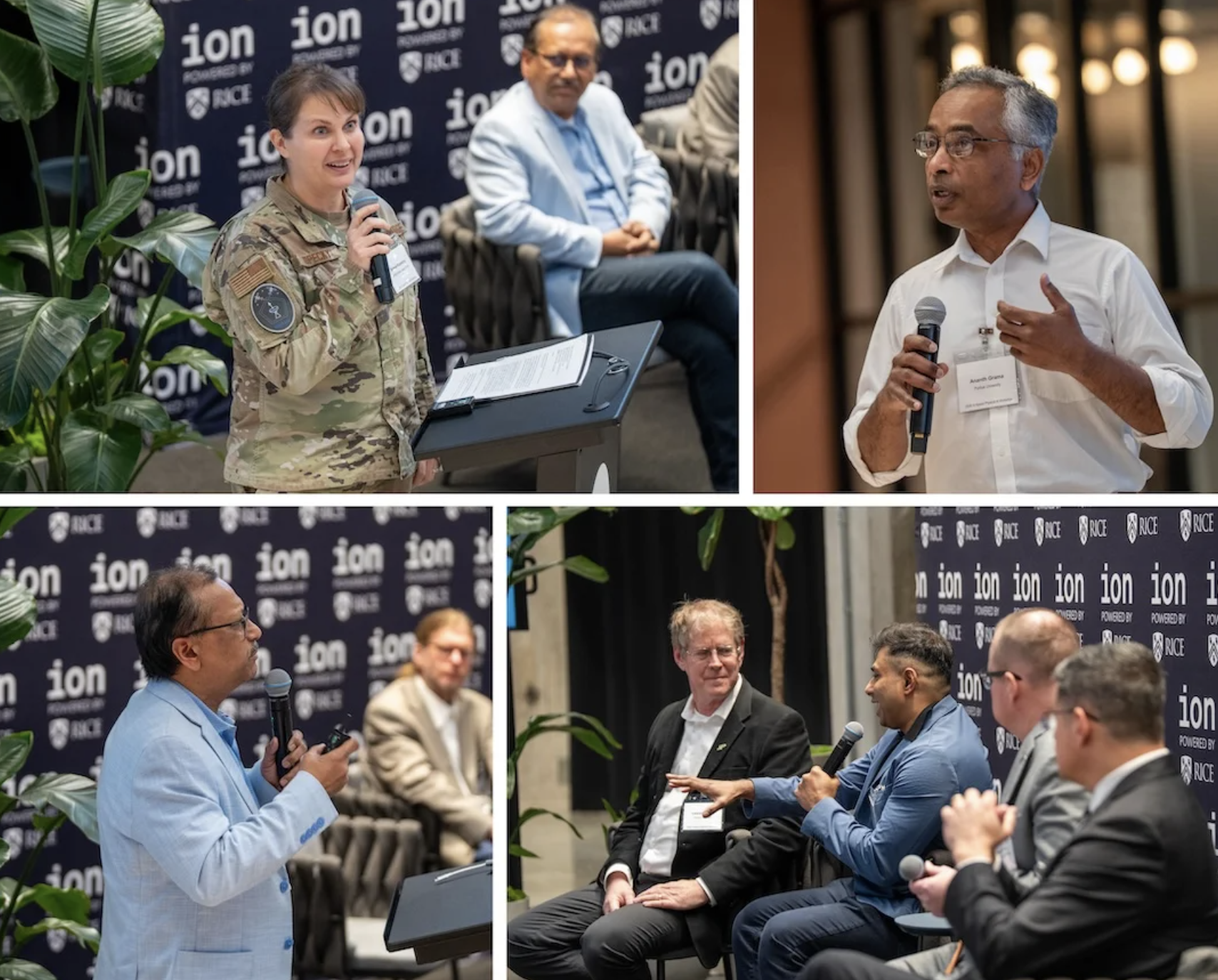
(Photos by Jared Jones/Rice University)
“One of the highlights this year was the depth of discussion on integrating sensing, actuation and AI into closed-loop medical systems,” said Xiaoguang Dong, assistant professor of mechanical engineering and biomedical engineering at Vanderbilt. “The constraints of space demand compact, autonomous and highly reliable technologies — driving innovation in wearable bioelectronics and robotic intervention platforms. At Vanderbilt, we are advancing soft, sensor-integrated medical robotics, and it was exciting to see complementary strengths at Rice and across the broader community. Meaningful progress in autonomous health care, in space and on Earth will come from continued collaboration among institutions like Vanderbilt, Rice and NASA.”
A third theme, defending the homeland, examined how physical AI intersects with national security priorities in the space domain. Sessions on missile defense and physical-AI-augmented operations surfaced a cluster of issues that show up whenever autonomy becomes operational: speed and latency, sensor fusion, coordination across distributed systems and, as a recurring motif, resilience. The fourth theme, international collaboration, addressed how AI is changing the texture of multilateral space activity, where commercial, government and academic actors increasingly share environments, data streams and operational dependencies.
Alongside panels and technical talks, the workshop also included a pitch and poster session that highlighted startups and early stage teams building in this space. One of the presenters was a group of Rice MBA students promoting TZ-II OrbitalTom, a rover prototype designed for autonomous mining and excavation in extreme environments on Earth and in space.
“Tom is built to operate where humans cannot, both on Earth and in space,” said Madhulika Annam, co-founder of Torres Orbital Mining, the startup working to commercialize the rover technology. “On Earth, it performs excavation and material handling in hazardous mining environments that are unsafe or inaccessible for people, improving cycle times and operational efficiency. In space, its value lies in our patent-pending mining technology adapted specifically for lunar regolith extraction, combined with onboard edge AI that enables safe, autonomous navigation and decision-making. This allows the rover to operate independently of constant lander instructions, a critical capability in environments where communication delays make remote control unreliable.”
Two keynote speakers from companies active in space exploration provided industry perspectives on physical AI. Matt Ondler, president of Aegis Aerospace, said AI will shape the future of space operations while emphasizing the importance of human-AI teaming and workforce readiness. Steve Smith, flight systems director at Blue Origin, described his company’s push to reduce launch costs through reusable systems and AI-enabled engineering, highlighting lunar initiatives aimed at building sustainable space infrastructure using in-situ resources.
Academic talks delivered by invited speakers from Purdue focused on biology and manufacturing in space. Marshall Potterfield, professor of biological engineering and space biophysics, discussed efforts to combine advanced sensing, data analysis and modeling to better monitor and sustain human health and other biological systems during long missions, while Ajay Malshe, inaugural director of the Manufacturing and Materials Research Laboratories at Purdue, argued that resilience must underpin the next phase of space manufacturing and assembly as activity in orbit expands.
Over two days, the workshop offered a concentrated view of where physical AI in space is headed: toward systems that can handle uncertainty and remain reliable in harsh environments, while still meeting the verification and safety expectations that spaceflight demands.